Back from OpenText World 2026: AI, smarter testing and some long-awaited improvements
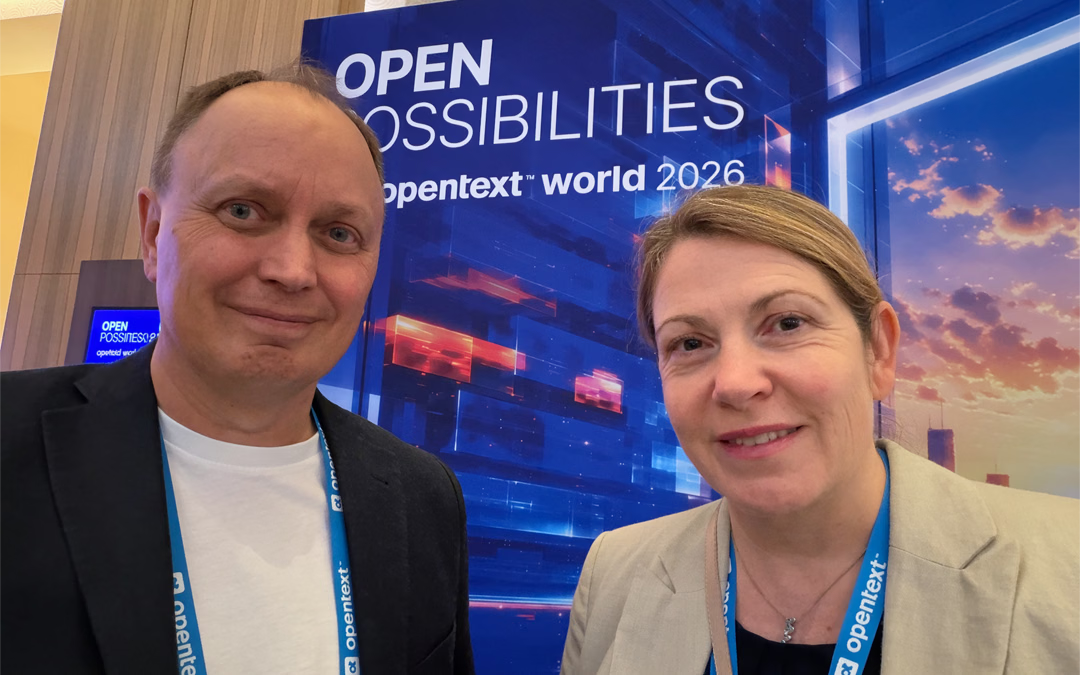
We’ve just returned from OpenText World 2026 in Orlando, where we had the opportunity to catch up with the OpenText team, exchange experiences with fellow partners and customers, and get a closer look at what’s new and what’s coming in OpenText Communications.
As always, one of the most valuable parts of these events is meeting people who work with the same technology and face many of the same challenges. Beyond the presentations and demonstrations, the conversations provide a great opportunity to exchange ideas and perspectives on where Customer Communications Management (CCM) is heading.
This year, several developments caught our attention. In particular, the progress in AI-assisted design, automated testing and some very welcome improvements for customers moving from older platforms.
AI that could genuinely make a difference
AI was, surprise surprise, a major theme throughout the conference. What we found particularly encouraging was OpenText’s focus on practical applications rather than simply adding AI for the sake of it.
One of the more interesting demonstrations was the AI Design Agent for OpenText Communications Designer.
The vision is to let developers use natural language to create and modify communication designs, including tables, text elements, business rules and other design objects. Another interesting capability will be the possibility of generating initial designs from existing PDF documents, Word files or images.
Anyone who has worked on a CCM migration knows how much effort can go into recreating existing communications. While AI won’t eliminate the need for experienced developers, it has the potential to significantly reduce repetitive work and accelerate the initial design process.
OpenText also demonstrated AI assistance for working with business rules and JavaScript, helping developers create, understand and improve logic.
And importantly, the AI capabilities are not limited to developers. OpenText is also exploring knowledge-driven authoring, allowing customer-facing employees to create more relevant communications using trusted business content and customer context.
The common theme is clear: AI should help people work more efficiently while keeping control over the communication process.
Testing is getting the attention it deserves
Another area that particularly impressed us was the progress in testing.
Testing has always been one of the more challenging aspects of CCM development. A single communication can contain numerous business rules, conditional sections and data-dependent variations. Ensuring that everything works correctly across all possible scenarios can be both complex and time-consuming.
OpenText’s new Test Suites capabilities aim to make this considerably easier.
They provide a more structured way to organise, execute and monitor communication tests, with the possibility of grouping critical communications into regression test suites.
Even more interesting is the introduction of AI-assisted test data generation. Instead of manually preparing input files for different scenarios, AI can help generate test data covering all the various combinations created by business rules over the communication.
Looking further ahead, the roadmap also includes automated output comparisons, AI-assisted generation of test suites based on recent changes, and the ability to select different engine versions for testing.
For organisations managing hundreds or thousands of communications, these capabilities could make a real difference.
In our view, better testing is one of the most important improvements OpenText can make to the platform. It has the potential to reduce the effort involved in upgrades, improve quality and make more frequent releases a realistic option.
Finally, native support for ZPL labels!
Not every important improvement needs to involve AI 😊
One announcement we were especially pleased to see was native support for ZPL (Zebra Programming Language) label output in OpenText Communications.
For customers using StreamServe in manufacturing, logistics and other environments where label printing is an essential part of the communication landscape, this has been a long-awaited capability.
Historically, label printing was one of the areas that could complicate a move from StreamServe to the newer Communications platform.
Native ZPL support helps address that gap and makes the modernisation path more attractive for customers with mixed document and label-printing requirements.
Sometimes it’s the seemingly smaller additions that remove the biggest practical obstacles.
A more complete platform, not just more features
Beyond AI, testing and labels, OpenText also highlighted a number of improvements that show the platform continuing to mature.
These include enhanced formatting capabilities, MQ input and output connectors, improvements to print output optimisation, and ongoing development of the browser-based design environment.
We also saw the direction of the new Message Campaigns functionality, intended to make it easier to manage and reuse campaign content across customer communications.
Another interesting direction is closer integration between OpenText Communications and Experience Cloud, bringing communication creation, orchestration and customer engagement into a more unified environment.
For us, the important question is always how these capabilities work together in real customer implementations and how they can simplify existing architectures rather than introduce additional complexity.
And perhaps a little more alignment between Communications and Core Communications?
One particularly interesting conversation was about the potential for closer alignment between OpenText Communications and Core Communications, OpenText’s SaaS offering.
When we raised the question, there were some encouraging hints that the two platforms might become more closely aligned in the future.
Could that eventually mean bringing the orchestration capabilities of Communications into Core Communications as well? Nothing officially announced, of course, but we’re keeping our fingers crossed! 😊
Communications 26.4 and beyond
The roadmap presented at OpenText World offered a useful indication of where the platform is heading.
As mentioned OpenText outlined the AI-assisted design and testing capabilities for version 26.4, alongside improvements in personalisation, migration tooling and campaign management. Version 26.4 is planned to be released before end of November this year.
Looking towards version 27.2, the ambitions extend to more advanced natural-language design, AI-assisted translation of existing business logic, and better deployment management through capabilities such as snapshots and rollbacks.
These are roadmap plans, of course, as always their availability and scope may change.
Nevertheless, the direction is promising, particularly for organisations looking to modernise established CCM environments without losing the capabilities they depend on today.
Our takeaways from Orlando
We came away from OpenText World 2026 with a positive impression of the direction OpenText Communications is taking.
What stands out is not one revolutionary feature, but a combination of improvements addressing some very familiar challenges: reducing development effort, making testing more manageable, simplifying migration and improving the everyday experience of working with the platform.
At Doctricks, we work closely with organisations developing, operating and modernising their customer communications solutions. We’re looking forward to putting these new capabilities to the test and seeing how they can create practical value for our customers.
Not to forget, in US it was the start of Hallowen season
Happy Hallowen from us all at DocTRICKs!
_